




Summary
Homeowners insurance usually covers a roof leak when a sudden, accidental event caused it, such as a windstorm, a falling tree or limb, or the weight of snow and ice. It usually does not cover leaks caused by age, wear and tear, or skipped maintenance. Your policy decides the details, so read it or ask your agent before you assume either way.
Key Takeaways
- Insurers separate sudden damage, which is often covered, from gradual wear, which usually isn’t.
- Water damage inside your home from a covered roof leak is often covered even when the worn roof part itself is not.
- The Oregon Division of Financial Regulation notes that wind damage to a few shingles typically means replacing those shingles, and damage on one side usually means paying for only that slope.
- Both the Washington and Oregon insurance regulators advise weighing your deductible and claims history before you file.
- In Washington, you choose your own contractor, according to the Office of the Insurance Commissioner.
- Stop further damage right away, document everything, and hold off on permanent repairs until your insurer has seen the damage.
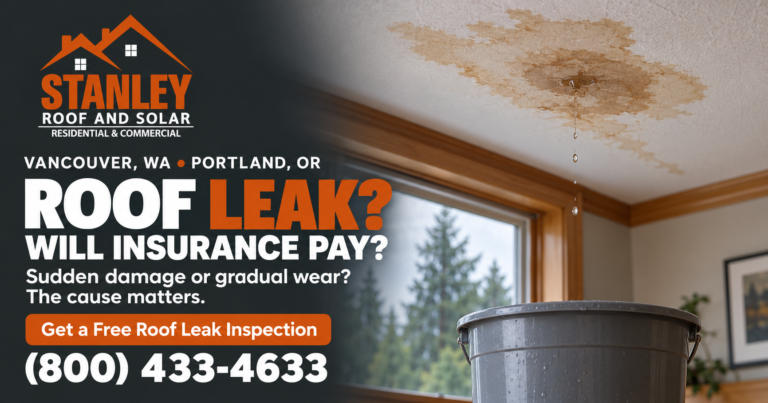
A ceiling stain after a stormy night raises two questions at once: how bad is the leak, and will insurance pay for it. This guide answers the second one for homeowners in Vancouver, Clark County, and the Portland metro, using guidance from Washington’s and Oregon’s insurance regulators. For the leak itself, see our roof leak repair page.
What Homeowners Insurance Usually Covers, and What It Doesn’t
| Cause of the Leak | Usually Covered? | Why |
|---|---|---|
| Windstorm tears off or lifts shingles | Often yes | Sudden damage from a named peril on most policies |
| Tree or large limb falls on the roof | Often yes | Sudden, accidental damage |
| Ice dam or ice storm forces water inside | May be covered | Oregon’s regulator says sudden water damage from an ice dam may be covered. Confirm with your insurer. |
| Worn pipe boot or aging shingles | Usually no | Wear and tear is treated as maintenance |
| Moss lifting shingles | Usually no | Considered a maintenance issue |
| Slow leak that went on for months | Often no | Long-term, gradual damage is commonly excluded |
| Interior water damage from a covered leak | Often yes | Drywall, insulation, and belongings may be covered even if the roof part isn’t |
| Groundwater seepage or backed-up drains | Generally no | Oregon’s regulator lists these as generally not covered |
Why “Sudden” vs. “Gradual” Matters So Much Here
Many Pacific Northwest roof leaks are slow ones. Months of light, steady rain can find a cracked pipe boot or a lifted shingle and seep in quietly for weeks before a stain shows up. That gradual pattern is exactly what policies tend to exclude, and so is damage from moss lifting shingles. Our guide on removing roof moss explains how to prevent it.
Our sudden events are mostly wind and ice. Strong east winds funnel out of the Columbia River Gorge in winter and hit hardest near its west end, in east Multnomah County and around Camas and Washougal. Ice storms like the one that hit the Portland area in January 2024 bring down limbs across Vancouver and Portland. The National Weather Service office in Portland issues wind and ice warnings for both sides of the river. If a leak shows up right after one of those events, write down the date and take photos immediately. A clear timeline helps show the damage was sudden.
Will Insurance Pay for a Whole New Roof?
Usually only if the covered damage is widespread. The Oregon Division of Financial Regulation explains that wind damage to a few shingles typically leads to replacing those shingles, not the whole roof, and that damage on one side normally means the insurer pays for only that slope. How much you’re paid also depends on whether your policy pays replacement cost or actual cash value, which subtracts depreciation for the roof’s age.
If your roof was already near the end of its life, a partial payout may not make a patch worth it. Our guide to roof repair vs. replacement walks through that decision.
How to File a Roof Leak Claim
- Stop further damage. Both states expect you to prevent damage from getting worse. Put out buckets, move belongings, and get the roof tarped. Keep the receipts. Our emergency roofing team can tarp an active leak the same day.
- Document everything. Take photos and video of the roof, the ceiling, and anything damaged inside, and note the date of the storm.
- Weigh the deductible. Washington’s Office of the Insurance Commissioner points out that insurers consider your claims history, so a claim only slightly larger than your deductible may not be worth filing.
- Call your insurer or agent. Ask what your policy covers, what your deductible is, and whether you have replacement cost or actual cash value coverage.
- Hold off on permanent repairs. Oregon’s regulator advises waiting until the insurer has inspected the damage.
- Get your own roofer’s assessment. A written scope with photos gives you something to compare against the adjuster’s estimate. Learn more on our storm damage roof repair page.
- Choose your contractor carefully. In Washington, the homeowner picks the contractor. Get any guarantees in writing, and be cautious about signing an “assignment of benefits,” which the Commissioner warns can limit your control over the claim.
Where to Get Free Help With a Claim
- Washington: The Office of the Insurance Commissioner explains your rights during a claim, including appraisal if you and your insurer disagree on the amount.
- Oregon: The Division of Financial Regulation’s consumer advocates answer claim questions for free at 888-877-4894.
How Stanley Roof and Solar Helps After a Leak
We’re licensed in both Washington and Oregon, so we work with homeowners on either side of the Columbia, including storm damage roofing in Vancouver and roof repair in Portland. When a leak needs repair, our free roof inspection traces it to the source and documents what we find with photos. If the damage came from a storm, that documentation helps when you talk to your adjuster. An inspection done only to document a roof for an insurance company, with no repair planned, is a separate service, and we’ll explain what’s involved before scheduling it.
Schedule a Free Roof Leak Inspection
Whether or not insurance ends up paying, the leak needs to be found and fixed before it spreads. Contact Stanley Roof and Solar or call (800) 433-4633 to schedule a free inspection anywhere in Vancouver, WA and the Portland metro.
Stanley Roof and Solar
Address: 7202 NE Hwy 99 Ste 106-210, Vancouver, WA 98665
Phone: (800) 433-4633
Google Maps: Find Us Here
Email: info@stanleyroofandsolar.com
Hours: Open 24 hours, 7 days a week
FAQs About Insurance and Roof Leaks
Does homeowners insurance cover roof leaks from heavy rain?
Usually not when rain alone gets through a worn roof. If a storm first damaged the roof, for example by tearing off shingles, the resulting leak is more likely to be covered. Check your policy’s wording on wind, rain, and gradual damage.
Will insurance pay for a new roof if mine is old?
Not for age alone. Insurers cover sudden damage, not wear. If an older roof is damaged in a storm, a policy that pays actual cash value will subtract depreciation, so the payout can be much lower than the cost of a new roof.
What is the difference between replacement cost and actual cash value?
Replacement cost coverage pays to repair or replace damaged roofing with similar new material. Actual cash value pays that amount minus depreciation for the roof’s age. Your declarations page shows which one you have.
Should I file an insurance claim for a small roof leak?
Maybe not. Washington’s Office of the Insurance Commissioner notes that insurers consider your claims history, so if the repair costs only slightly more than your deductible, paying for it yourself may be the better choice.
Can I choose my own roofer for an insurance claim in Washington?
Yes. Washington’s Office of the Insurance Commissioner says homeowners can choose their own contractor. Get any guarantees in writing and be careful about signing an assignment of benefits.
What should I do first when my roof starts leaking?
Stop the damage from spreading. Catch the water, move belongings, and get the roof tarped, then photograph everything and call your insurer. Keep receipts for any emergency work.
Does homeowners insurance cover roof damage from moss?
Generally no. Moss damage builds up slowly and is treated as a maintenance issue. Regular moss treatment is the best protection.
Who can help if my roof claim is denied?
In Washington, contact the Office of the Insurance Commissioner. In Oregon, the Division of Financial Regulation’s consumer advocates help for free at 888-877-4894. A written assessment from a licensed roofer can also support your case.